The Øresund Link: A Vision Realized
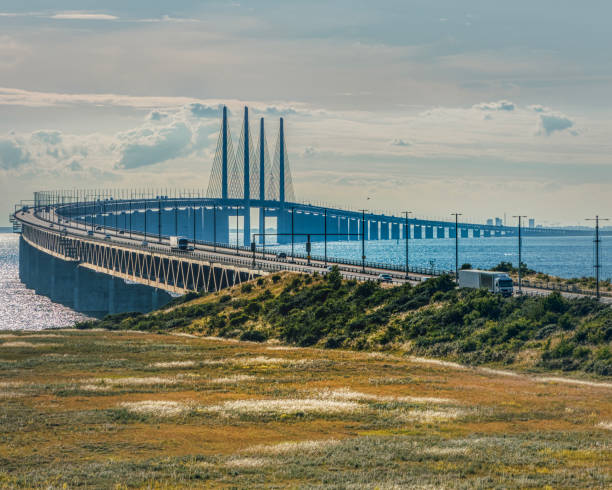
The Øresund Bridge represents one of Europe's most ambitious infrastructure projects. This combined road and rail link spans nearly 8 kilometers across the Øresund strait, connecting Copenhagen, Denmark with Malmö, Sweden. Completed in 2000, the bridge has become an iconic symbol of Nordic cooperation and engineering excellence.
The project was not merely about connecting two cities—it was about uniting two nations and creating a unified Scandinavian region. The bridge fundamentally transformed transportation, commerce, and cultural exchange between Denmark and Sweden.
Historical Development
1800s-1930s: Early Dreams
Ideas for a fixed link across the Øresund date back to the late 1800s. In 1910, proposals were submitted to the Swedish Parliament for a railway tunnel. The concept of a bridge was formally proposed in 1936 as part of Denmark's national motorway network planning.
1950s-1960s: Serious Planning
In 1954, the first Øresund Delegation was appointed to investigate conditions for a bridge link. By 1962, detailed proposals emerged for a 53-meter tall reinforced concrete bridge. However, disagreements about placement and form delayed progress.
1970s-1980s: Political Decisions
Denmark and Sweden signed an initial agreement in 1973, but the project was cancelled in 1978 due to economic concerns and environmental opposition. As economic conditions improved in the 1980s, interest resumed, leading to a new agreement in 1991.
1992-1995: Design & Procurement
A design competition was launched in 1992. Six entries were submitted, including proposals from Santiago Calatrava and Norman Foster. The winning design by the ASO Group featured a cable-stayed bridge with steel construction. Construction contracts were signed in November 1995.
1995-1999: Construction
Construction began in 1995 with a consortium of Skanska, Hochtief, Højgaard & Schultz, and Monberg & Thorsen. The project faced significant technical challenges, including complex geological conditions and environmental requirements. The bridge sections were assembled using the world's largest hammerhead crane barge.
July 1, 2000: Grand Opening
The Øresund Bridge officially opened to traffic on July 1, 2000. The inauguration ceremony was attended by dignitaries from both nations, marking a historic moment in Nordic cooperation. The bridge has since become a vital transportation link and cultural symbol.
Engineering Achievements
Technical Specifications
- Total Length: 7,845 meters (25,738 feet)
- Bridge Section: 7,845 meters
- Tunnel Section: 4,050 meters (immersed)
- Main Span: 490 meters (1,608 feet)
- Height: 204 meters (669 feet)
- Width: 23.5 meters (77.1 feet)
Design Features
- Type: Cable-stayed bridge
- Traffic Capacity: 4 lanes (2 each direction)
- Rail Capacity: Double-track Øresund Line
- Design Life: 100+ years
- Wind Resistance: 61 m/s (217 km/h)
- Earthquake Resistance: Advanced seismic design
Design Innovation
The bridge combines both roadway and railway in a single structure, an innovative approach that required sophisticated engineering solutions. The cable-stayed design provides both structural efficiency and visual elegance.
The Tunnel Section
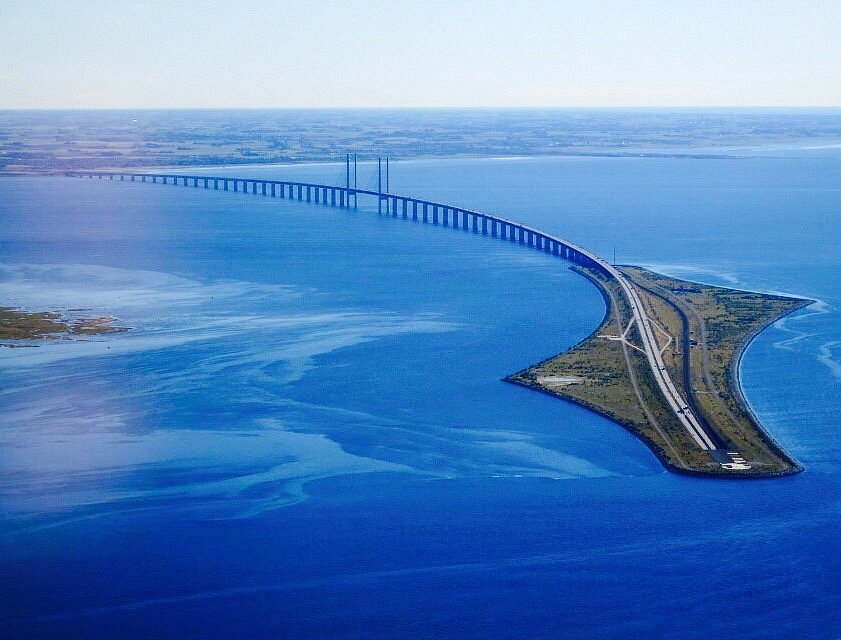
A crucial design decision involved incorporating an immersed tunnel section from Peberholm to Kastrup. This approach:
- • Avoids interference with Copenhagen Airport flight paths
- • Maintains clear shipping channels for large vessels
- • Prevents ice floes from blocking the strait in winter
- • Reduces environmental impact on the strait
Environmental Considerations
The bridge was designed with rigorous environmental standards. The immersed tunnel approach, while more complex and expensive, was chosen to minimize ecological disruption. The project included extensive environmental monitoring and mitigation measures.
Impact & Legacy
Economic Impact
The bridge has transformed the regional economy, facilitating increased trade, tourism, and business connections. It has reduced transportation costs and travel times, making cross-border commerce more efficient.
- • Daily traffic exceeds 25,000 vehicles
- • Increased tourism in both regions
- • Enhanced business opportunities
- • Regional economic integration
Cultural Significance
Beyond its practical function, the bridge symbolizes Nordic cooperation and unity. It has become an iconic landmark representing modern European infrastructure and international collaboration.
- • Symbol of Nordic cooperation
- • Architectural landmark
- • Tourist attraction
- • Cultural bridge between nations
Recognition & Awards
The Øresund Bridge received the 2002 IABSE Outstanding Structure Award, recognizing its exceptional engineering, design, and construction. The project has been studied as a model for international infrastructure cooperation and complex engineering challenges.